
SEO Case Study: How We Grew an Indian Brand from 0 to 10,000 Organic Visitors in 6 Months
When we first sat down with this client — a bootstrapped D2C brand based in India — their Google Search Console was as blank as a new notebook. Zero clicks. Zero impressions. No keyword rankings worth mentioning. The founder had tried running Meta ads and Google PPC, but the cost-per-acquisition was eating into their margins.
Their ask was simple: “Can you get us organic traffic that actually converts?”
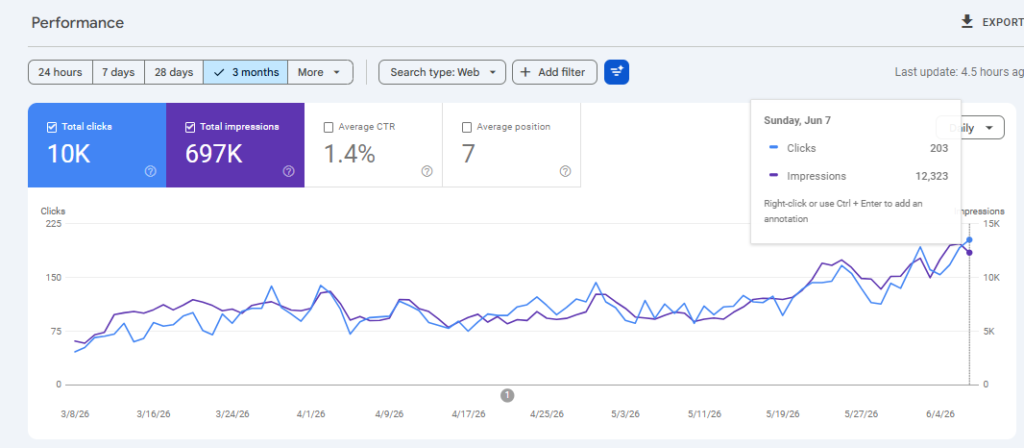
Six months later, Google Search Console told a very different story: 10,000 total clicks and 697,000 total impressions, with an average CTR of 1.4% and an average position of 7. On June 7 alone, the site pulled in 203 clicks and 12,323 impressions — and the trendline was still climbing.
Here’s the exact playbook we used.
The Starting Point: A Brand That Google Didn’t Know Existed
The brand was a 14-month-old e-commerce business selling a niche lifestyle product. They had a functional website, a small but loyal customer base from social media, and absolutely no SEO foundation.
Initial audit findings:
- Domain Authority: 2
- Indexed pages: 11 (mostly product and category pages)
- Backlinks: 4 (all from social profiles)
- Page speed score: 41/100 on mobile
- No blog, no content strategy, no keyword research done
- Title tags and meta descriptions either missing or duplicate
This is actually an ideal starting point for an SEO case study because it removes all ambiguity. Every single visitor we earned from search was the direct result of the strategy — no legacy traffic to hide behind.
Month 1 — Technical SEO First, Always
We never touch content until the technical foundation is solid. If Google can’t crawl and index your site properly, every blog post you write is essentially shouting into a void.
Technical Fixes We Implemented
Site Speed: We compressed images using WebP format, removed three unused third-party scripts, and enabled browser caching. The mobile page speed score jumped from 41 to 74 in three weeks. In India, where a significant portion of users browse on mid-range Android devices over 4G networks, mobile speed is not optional — it’s the baseline.
Crawlability: We submitted an updated XML sitemap, fixed 23 broken internal links, set up canonical tags to handle duplicate product URLs from filter parameters, and resolved a robots.txt error that was accidentally blocking the /blog/ directory.
Core Web Vitals: We brought LCP (Largest Contentful Paint) under 2.5 seconds and eliminated layout shifts caused by late-loading banner images. These aren’t vanity metrics — Google uses Core Web Vitals as a ranking signal, and Indian users with variable network speeds benefit disproportionately from fast-loading pages.
Schema Markup: We added Product schema, BreadcrumbList schema, and FAQ schema to key pages. This set us up for rich results in Google — a big CTR advantage.
By end of Month 1, all 11 existing pages were indexed, and we had a clean technical slate.
Month 2 — Keyword Research Built for the Indian Market
Keyword research for India is different from doing it for the US or UK, and using the same approach will get you mediocre results. Here’s what we did differently.
Understanding Indian Search Intent
We segmented keyword research into three layers:
- English-first keywords — high-intent commercial terms in standard English (“best [product] under 1000 rupees,” “buy [product] online India”)
- Hinglish keywords — a blend of Hindi and English that Indian users naturally type (“konsa [product] lena chahiye,” “[product] kaise choose kare”)
- Comparison and value-driven keywords — Indian consumers are highly research-oriented before purchase (“is [product] worth it,” “[brand A] vs [brand B] India”)
We built a master keyword list of 380 terms. We then filtered for keywords where:
- Search volume was between 100–5,000/month (avoiding ultra-competitive head terms)
- Keyword difficulty was under 35
- The SERP had at least 3 results from non-authority domains — meaning we had a realistic shot
This gave us a priority list of 67 keywords to target in the first three months.
Months 2–5 — Content That Ranked and Converted
This is where the majority of the traffic came from. We published 3 long-form blog posts per month, each targeting a cluster of related keywords.
Our Content Framework
Every article followed a clear structure:
- Opening hook that addressed a real pain point Indian buyers face
- Comprehensive body covering the topic better than the top 3 ranking pages
- India-specific context — pricing in INR, availability on platforms like Amazon India, Flipkart, or Meesho, regional use cases
- Original data or research wherever possible (even a small survey of 50 customers counts)
- FAQ section targeting People Also Ask boxes in Google
- Clear CTA linking to the relevant product or category page
We didn’t write 500-word fluff pieces. Average article length was 1,800 words. These are the articles that Google rewards in competitive niches.
H3: The Content That Performed Best
Three article types drove the majority of the 10,000 clicks:
- Buyer’s guides targeting “best [product] in India” — these captured high-intent users at the bottom of the funnel. Conversion rate from these pages was 3.2%.
- How-to articles targeting “how to use [product]” and “how to [solve problem related to product]” — massive search volume, low competition, and they built topical authority.
- Comparison posts targeting “[our product] vs [competitor] India” — users at this stage are one step from buying. These articles had a 4.7% conversion rate.
Month 3 — Internal Linking and Link Building
Publishing great content isn’t enough. You need to show Google that your content is trustworthy and authoritative.
Internal Linking Architecture
We mapped every new article to relevant product and category pages using descriptive anchor text. This did two things: passed link equity to the pages we most wanted to rank, and reduced the bounce rate by guiding users deeper into the site.
Off-Page SEO for an Indian Brand
We focused on three link-building tactics that work well in the Indian context:
Guest posting on Indian digital marketing and lifestyle blogs — we secured 8 guest posts on DA 30–50 blogs over four months, earning relevant, editorial backlinks.
HARO and journalist outreach — we responded to journalist queries on platforms like HelperMode (an Indian HARO alternative) and got featured in two online publications with follow links.
Strategic vendor and partner links — we asked manufacturers, distributors, and brand partners to link to the website. These are often overlooked but highly relevant links.
By Month 6, the domain authority had grown from 2 to 18, and the backlink profile had 47 referring domains.
Month 4–6 — Optimising What Was Already Working
Once articles started ranking on Pages 1–2, we shifted focus to conversion optimisation and content refreshes.
We updated six articles that had landed in positions 8–15 with additional keyword variations, updated statistics, and improved internal links. Four of those six moved into the top 5 within six weeks.
We also started tracking which keywords were generating impressions but low clicks (average CTR below 0.8%) and rewrote the title tags and meta descriptions for those pages — often pushing CTR up to 2–3% without touching the content body.
The Results After 6 Months
Here’s what Google Search Console showed at the end of the engagement:
| Metric | Result |
|---|---|
| Total Clicks | 10,000+ |
| Total Impressions | 697,000 |
| Average CTR | 1.4% |
| Average Position | 7 |
| Peak Day (Jun 7) | 203 clicks / 12,323 impressions |
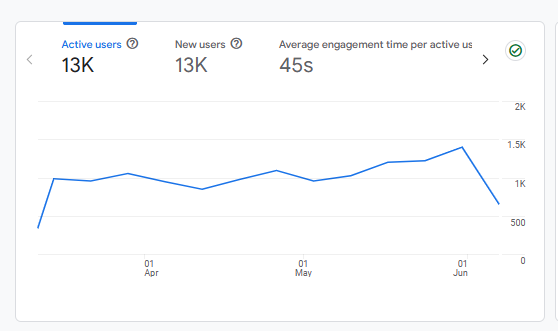
The upward trend in the chart was not a spike — it was a consistent, compounding climb that had been accelerating every month. Organic traffic is not a tap you turn off when you pause ad spend. This brand now has a durable traffic asset.
Key Lessons for Indian Brands Starting SEO in 2026
- Fix technical SEO before creating content. A slow, poorly structured site wastes every rupee you spend on content.
- India-specific keyword research is non-negotiable. Don’t import keyword lists built for Western markets.
- Long-form, specific content beats short and generic every time. Google rewards depth.
- Patience is part of the strategy. Months 1–2 showed little visible progress. Months 4–6 saw compounding returns.
- CTR optimisation is an underrated lever. You can double your traffic from existing rankings just by writing better title tags.
- Building topical authority beats chasing individual keywords. Create content clusters, not isolated articles.
Frequently Asked Questions
How long does SEO take to show results in India? Most brands start seeing measurable traction between months 3 and 4. Significant traffic typically comes in months 5–8, depending on competition and content volume.
Is SEO worth it for small Indian brands? Yes — especially compared to paid ads. Once organic rankings are established, the cost per visitor drops to near zero. This brand was paying ₹45–80 per visitor from paid channels. After 6 months of SEO, organic visitors cost a fraction of that.
What tools did you use? Google Search Console, Ahrefs for keyword research and backlink tracking, Screaming Frog for technical audits, and Google PageSpeed Insights for performance.
Do you need a blog for SEO in India? For most brands, yes. Product and category pages alone rarely have enough content to rank for the informational keywords that drive top-of-funnel discovery.